Agnes Baden-Powell
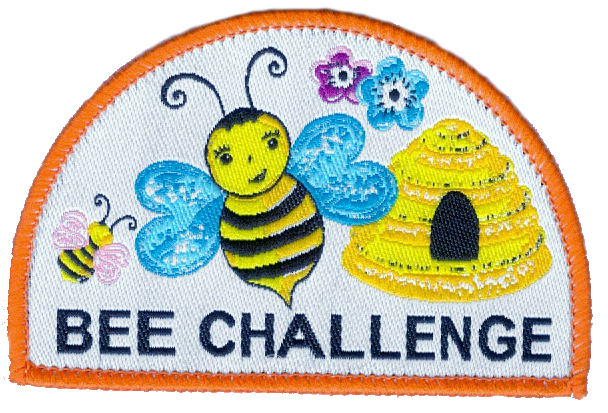
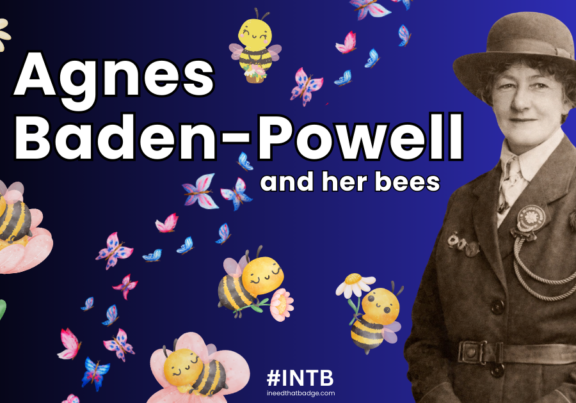
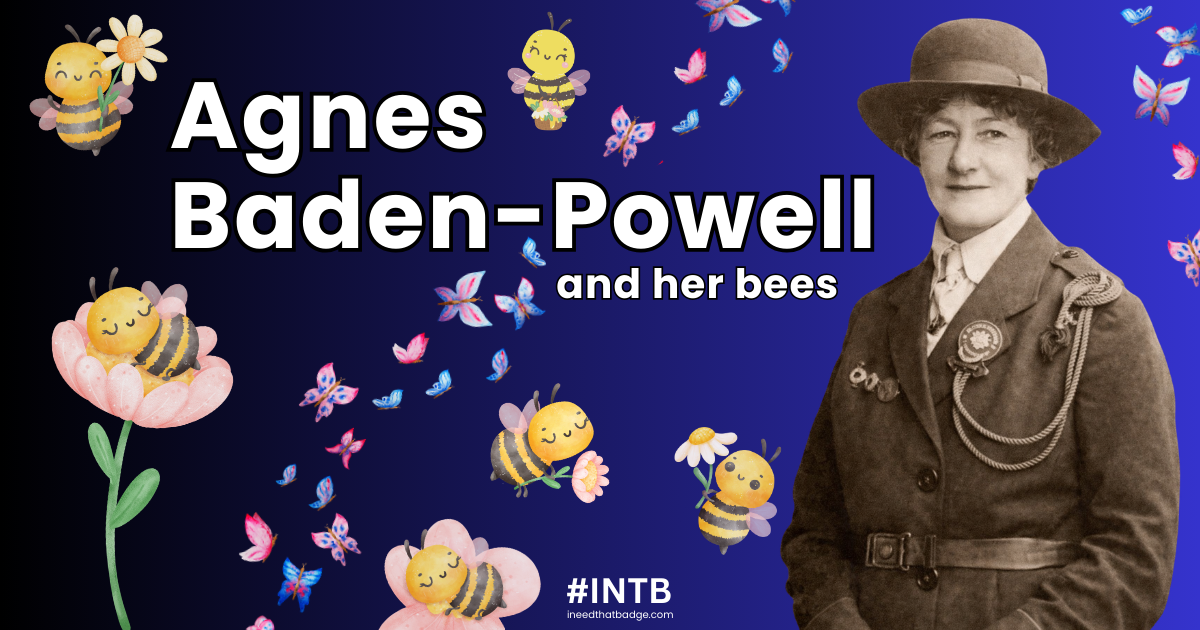
Agnes Baden-Powell would no doubt have enjoyed earning the Bee Challenge badge. She had a lifelong interest in the natural world, and one of her more unusual pursuits was beekeeping. At the family home in London — 8 St George’s Place — Agnes kept working beehives indoors in the drawing room. The hives were functioning colonies, and she studied them with genuine scientific curiosity.
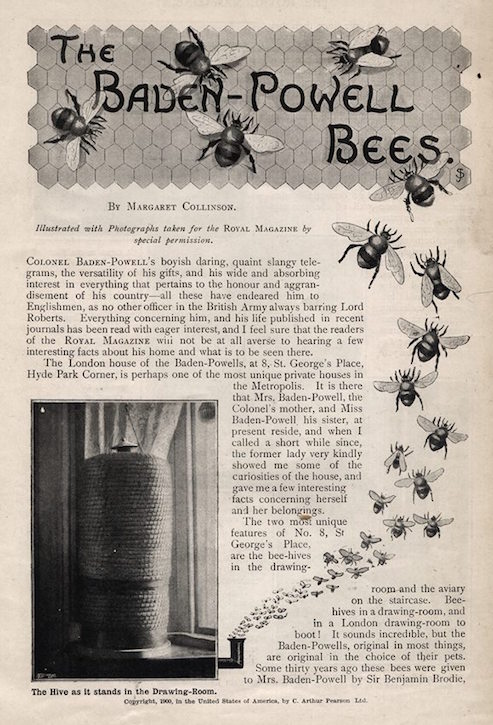 Her interest reflected a broader Victorian enthusiasm for natural science and amateur study. Beekeeping required observation, patience, and careful record-keeping — qualities Agnes later brought to her leadership in Guiding. Contemporary accounts describe visitors being shown the hives and listening to Agnes explain bee behaviour with enthusiasm and authority.
In 1900, The Royal Magazine published an article about ‘The Baden-Powell Bees’, highlighting the unusual indoor beehives with access to the outdoors via a pipe through the wall, tended
Not surprisingly, she was successful in producing prize-winning honey.
She also kept and studied butterflies and birds, reflecting her broad curiosity about entomology and natural science. Like many educated Victorians, she engaged in the careful collection, observation, and documentation of insect life. This was not unusual among scientifically minded hobbyists of the period, but it was quite unconventional for women at the time, as they were rarely encouraged to pursue scientific study seriously.
Agnes’s beekeeping and butterfly study were more than hobbies. They reflected:
- Scientific curiosity
- Independent thinking
- A willingness to step beyond traditional female expectations
- A commitment to hands-on learning
A Woman of Many Talents
Agnes Baden-Powell (1858–1945) was part of a large family, most of whom were boys. She was the only surviving daughter of Reverend Professor Baden Powell (1796–1860) and Henrietta Grace Smyth (1824–1914). The family surname was originally simply Powell. After the Reverend’s death in his sixties, Henrietta chose to honour him by incorporating his first name, Baden, into the family surname. As a result, the children of her marriage adopted the surname Baden-Powell: Warington, George, Augustus, Frank, Robert, Agnes, and Baden. This change did not affect the Reverend’s older children from his two previous marriages.
While all her brothers attended formal schooling, Agnes was home-schooled by her mother, which was common for girls of her social class in Victorian England. Henrietta strongly supported the education of girls and ensured that Agnes received a broad and thorough preparation. As a result, she developed a wide range of interests and accomplishments:
- Competed and won prizes in bicycle gymkhanas and played bicycle polo
- Enjoyed camping, fishing, sailing, shooting, tennis, and golf
- Raised birds in a aviary on the staircase and kept bees and butterflies
- Was proficient in painting, sewing, decorative metalwork, and lacemaking
- Had a keen interest in science, nature study, and astronomy
- Played the organ and piano and excelled in violin
- Spoke multiple languages (often reported as up to eleven, though exact fluency levels are debated)
- Was acquainted with Guglielmo Marconi, inventor of wireless telegraphy
- Went hot-air ballooning and was once reported to have reached a notable altitude record
- Became one of the early women members of the Royal Aeronautical Society
- Was well connected in the high society, including with the Royal family
- Received the British Red Cross War Medal during the First World War, and later served as Vice President of the Westminster Division
Her curiosity and enthusiasm for science and the outdoors were unusual for women of her era and influenced the educational nature of early Guiding.
Agnes Baden-Powell: The First Girl Guide
Although Scouting had been created for boys with no official structure for girls, by 1909 there were more than 6,000 girls registered with Scout Headquarters, often using only their initials. Along with about 11000 boys, hundreds of girls also attended the Crystal Palace Scout Rally organised by Baden-Powell, most having officially registered and paid for their tickets. Another group of girls reportedly arrived without booking and drew attention for effectively “gatecrashing” the event. That group received a disproportionate amount of publicity and is generally acknowledged as the impetus for starting the Guiding movement. In reality, an announcement in the August 1909 Headquarters Gazette indicated that plans were already underway for the formal creation of a separate organisation for girls.
Agnes was the sister of Robert Baden-Powell, founder of the Scout Movement. Although he is widely recognised as the founder of both Scouting and Guiding, and his wife Olave later served as World Chief Guide, it was Agnes who formally organised and shaped the Girl Guide movement during its formative years.
Recognising the enthusiasm and demand, Robert Baden-Powell asked Agnes to organise a separate movement for girls. In 1910, the Girl Guides Association was formally founded in the United Kingdom. Agnes served as President from its founding until 1917 when she reluctantly stepped down in favour of Princess Mary, remaining a respected figure as a Vice-President until her death in 1945.
Without Agnes, Guiding may never have developed into the worldwide movement it is today.
Agnes co-authored the first Girl Guide handbook in 1912, titled “The Handbook for the Girl Guides or How Girls Can Help to Build Up the Empire”, partially derived from Robert’s Scouting for Boys. The book adapted Scouting principles to suit girls of the time, encouraging outdoor skills, service, discipline, self-reliance, and practical competence.
Under Agnes’s guidance, Guiding spread rapidly across Britain and internationally.
Leadership and Later Years
As the Guiding movement grew, Robert Baden-Powell’s wife, Olave Baden-Powell, became increasingly involved. Agnes gradually stepped back from active administration but remained a respected figure within the movement. Agnes often referred to herself as ‘Grandmother of the Guides’. She continued camping and sleeping in tents until the age of 80.
Agnes died in 1945, having witnessed Guiding expand across continents.
Her Lasting Impact
Agnes helped alter the way society viewed the role of girls. At a time when expectations for girls were limited, she supported opportunities for:
- Outdoor adventure
- Leadership development
- Service and citizenship
- Skill-building beyond purely domestic roles
Guiding offered girls structured independence and confidence in a rapidly changing world.
While her brother’s name is widely recognised, Agnes Baden-Powell’s organisational skill, foresight, and dedication were instrumental in ensuring that girls had their own movement — one that continues to empower millions worldwide.
References and Further Reading
- Wikipedia contributors. (n.d.). Agnes Baden-Powell. Wikipedia. Retrieved February 22, 2026
- The Scout Association. (n.d.). Scouting for Girls. Scouts UK. Retrieved February 22, 2026
- Wikipedia contributors. (n.d.). 1909 Crystal Palace Scout Rally. Wikipedia. Retrieved 22 February 2026