💩 Lucey Alford – The Scientist Who Helped Save Melbourne from “Smellbourne”
Let’s award Lucey Ray Alford the Just Disgusting badge. She earned it while demonstrating that even the most disgusting problems can lead to remarkable scientific achievements.
Sewerage can definitely be disgusting. But studying bacteria in waste and investigating corrosion protects millions of people every day. In her time, Lucey showed that women belong in laboratories, in engineering organisations, and at the centre of public health innovation.
Behind Melbourne’s sewerage system was serious science — and one remarkable woman who helped protect the city’s infrastructure and public health.
Today, we simply flush it away. But in early Melbourne, waste management was one of the city’s biggest, smelliest, most disgusting challenges.
The Early Days: Night Soil and Open Drains
When Melbourne was established in the 1830s, there was no sewerage system at all. Homes relied on:
- Chamber pots
- Backyard cesspits
- Outhouses
- Open street drains
Human waste was collected by workers known as “night soil men”, who carted it away after dark to reduce public embarrassment — and smell. The waste was often dumped on the outskirts of town, used as fertiliser, or discharged into waterways like the Yarra River.
During the booming gold rush of the 1850s, Melbourne’s population exploded and it became Australia’s largest city. But sanitation systems did not keep pace. Street gutters were filled with raw sewage and horse manure, and rivers with effluent from factories and abattoirs. The result was:
- Contaminated drinking water
- Foul odours
- Frequent outbreaks of typhoid and other water-borne diseases
- Polluted rivers and creeks
By the 1880s, Melbourne was sometimes referred to as “Smellbourne”.
Proper Sewerage System Became Urgent
By the late 19th century, it was clear that Melbourne needed a coordinated, city-wide sewerage network. In 1891, the Victorian Government established the Melbourne and Metropolitan Board of Works (MMBW) to manage water supply and sewerage. Engineers studied systems overseas and designed a massive underground network to carry sewage away from homes and businesses.
The engineering breakthrough provided a system included:
- Underground brick and concrete sewer tunnels
- Large pumping stations
- Rising mains (pressurised pipes)
- A major treatment and disposal area at Werribee
💧 From Disgusting to Essential
Melbourne’s early sewerage system was one of the largest infrastructure projects in Australia at the time. What began with night soil carts and open drains evolved into a sophisticated underground network supported by engineering and science. It transformed public health outcomes:
- Reduced typhoid outbreaks. Previously, the death rate from typhoid in Melbourne was higher than in London.
- Cleaner waterways
- Safer drinking water
- Improved life expectancy
One of the most important sites was the Spotswood Pumping Station, completed in 1897. Because much of Melbourne is relatively flat, gravity alone could not move all the sewage. At Spotswood, enormous steam-powered pumps lifted sewage so it could continue flowing westward. From there, it was transported to Werribee.
The Werribee Solution: Sewage Farms
Instead of discharging untreated waste straight into Port Phillip Bay, Melbourne used an innovative method for the time: land filtration (sewage farming), which was world-leading technology at the turn of the century. At what is now the Western Treatment Plant, sewage was spread across large paddocks.
The method worked like this:
- Sewage was distributed over grassed fields.
- Soil and microorganisms broke down organic matter.
- Plants absorbed nutrients.
- Partially treated water filtered through the soil.
This system reduced pollution entering waterways and also produced crops such as pasture for grazing animals.
It was a major improvement on dumping waste directly into rivers, but it was messy and challenges emerged:
- Concrete corrosion caused by sewer gases
- Bacterial activity damaging infrastructure
- Odour control
- Water quality monitoring
This is where scientists, including bacteriologists like Lucey Ray Alford, later played an important role. Their understanding of how bacteria behaved inside sewer tunnels helped protect Melbourne’s infrastructure and improve treatment processes.
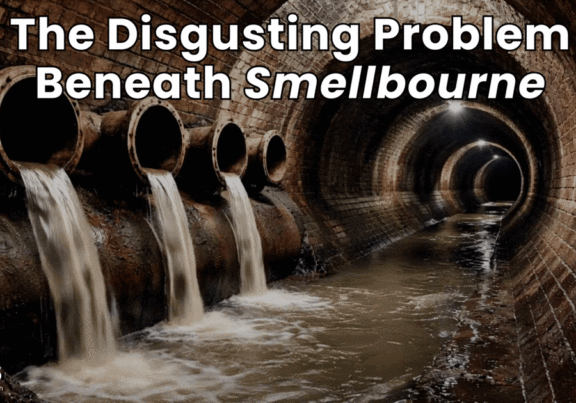
The Disgusting Problem Beneath the City
Melbourne’s vast sewerage network relied on massive pumping stations, including the one at Spotswood. But something strange began to happen underground. The concrete pipes and tunnels were deteriorating far faster than expected. Corrosion was damaging infrastructure. Sewer gases were creating strong odours. Maintenance costs were rising.
The problem was unpleasant, expensive and potentially dangerous.
The culprit? Bacteria.
Certain types of bacteria in sewerage systems produce acids that corrode concrete and metal. Without understanding the biology, engineers could not fully solve the engineering problem.
This is where Lucey Alford’s work became critical.
From University Graduate to Wartime Scientist
Lucey Ray Alford graduated from the University of Melbourne in 1936 with a Bachelor of Science (Honours). At a time when few women pursued scientific careers, she specialised in microbiology and laboratory science.
After university she worked in pathology at Royal Perth Hospital and later with CSIRO in Sydney. Her skills were highly technical and in demand — especially during World War II
In 1941, during the war, she was appointed Assistant Bacteriologist at the Melbourne and Metropolitan Board of Works (MMBW). Many male scientists were serving overseas, and this created rare opportunities for women to step into scientific roles. She became the first woman employed in a scientific position by the MMBW. As she was the first female worker at the Pumping Station, a separate toilet was specially installed for her, shared the following year with two female laboratory assistants, Miss M. McNeil and Miss S.E. Gorham.
At the Spotswood Pumping Station laboratory, Alford studied the microorganisms living in Melbourne’s sewerage system. She investigated how bacteria were contributing to corrosion and infrastructure damage. By identifying and understanding the bacteria involved, she helped the Board of Works develop better strategies for managing sewer gases and protecting concrete linings.
Her work focused on Thiobacillus concretivorus – bacteria that “eat” the sulfur gas and excrete the acid that destroys the concrete. The results of her work directly supported:
- Reduced structural damage
- Lower maintenance costs
- Improved odour control
- Increased longevity of sewer infrastructure
It might have been disgusting, but it was essential. Without this research, Melbourne’s underground network could have faced serious long-term failure.
A Career in Water Science
After her initial wartime appointment, Alford continued working with the Board of Works. By 1943 she was managing water supply laboratories — a significant responsibility. She remained in scientific service until her retirement in 1975.
Over those decades she helped oversee testing that ensured Melbourne’s water and wastewater systems met safety standards. Quiet, methodical laboratory work — but vital for public health.
She also became a mentor and example for younger women entering laboratory science. Lucey built her career at a time when women in science were rare and often underestimated. She worked at the microscopic level — solving a problem engineers could not see.
Lucey’s appointment in 1941 was a direct result of the labor shortages caused by men enlisting, but her retention until 1975 proves her expertise was indispensable.
Her story reminds us that STEM is not just about machines and structures. It is also about biology, chemistry and careful observation. Melbourne’s sewerage system is not be visible to most of us — but it works because scientists like Alford understood what was happening beneath the surface.
Replacement, Closure and a New Era of Sewerage
By the early 1950s, Melbourne’s original sewerage scheme was beginning to show its age.
After heavy rainfall, the Spotswood Pumping Station struggled to keep up with the sewage flow from a city that had grown to nearly 1.5 million people. Although the steam engines at Spotswood had long been retired and replaced with electric pumps, the real weakness lay in the three ageing rising mains that carried sewage from Spotswood to Brooklyn.
After almost 60 years of service, the riveted wrought-iron and steel pipes had deteriorated badly. Hydrogen sulphide gas produced by sewage caused serious corrosion inside the pipes. During peak flow periods, pressure increased and the risk of pipe failure rose sharply.
On several occasions, pipes burst — sending raw sewage into gutters and through the backyards of nearby homes. Public outrage followed, and the Board of Works faced growing pressure to modernise the system.
In 1957, a major decision was made. A new pumping station would be built at Brooklyn, with twice the capacity of Spotswood. A 3.5-kilometre diversion tunnel would carry sewage from the Hobsons Bay and North Yarra Main Sewers directly to the new site.
The project cost £6¼ million — twice the cost of the entire original sewerage scheme — and took six years to complete. The Brooklyn Pumping Station officially opened on 11 September 1964. Over the next 12 months, sewage flow was progressively transferred from Spotswood to Brooklyn. In September 1965, the pumps at Spotswood fell silent for the final time.
Preserving Industrial History
After closure, the Spotswood site remained in use as a maintenance depot and engineering workshop for the Board of Works. Boiler houses were converted into repair workshops. Coal bunkers became storage facilities. Machinery was adapted and reused.
Importantly, several key staff recognised the historic significance of the original steam engines and pumping machinery. Through their efforts, major pieces of equipment — including the impressive Austral Otis steam engines — were saved from being scrapped.
In 1982, one of the historic pumping engines was restored and adapted to run on compressed air for public demonstrations. Open days allowed visitors to see inside the remarkable brick buildings and watch the machinery in action.
Today, the site is preserved as part of Melbourne’s industrial heritage.
How Sewage Is Processed Today
Melbourne’s sewerage system no longer relies on sewage farms alone.
Modern treatment at sites such as the Western Treatment Plant and the Eastern Treatment Plant uses a combination of:
- Mechanical screening to remove solids
- Biological treatment using carefully managed bacteria
- Aeration tanks that encourage microorganisms to break down waste
- Settling ponds and clarifiers
- Nutrient removal processes
- Disinfection before release
Instead of simply spreading sewage across paddocks, modern plants carefully control bacterial activity to break down organic matter more efficiently and safely.
The same microscopic organisms that once corroded pipes are now harnessed deliberately to clean wastewater.
Today, treated water is recycled for agriculture and industry, nutrients are managed to protect waterways, and strict environmental standards are monitored by scientists and engineers.