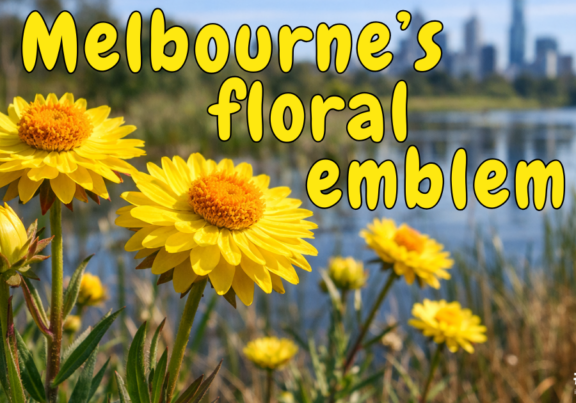
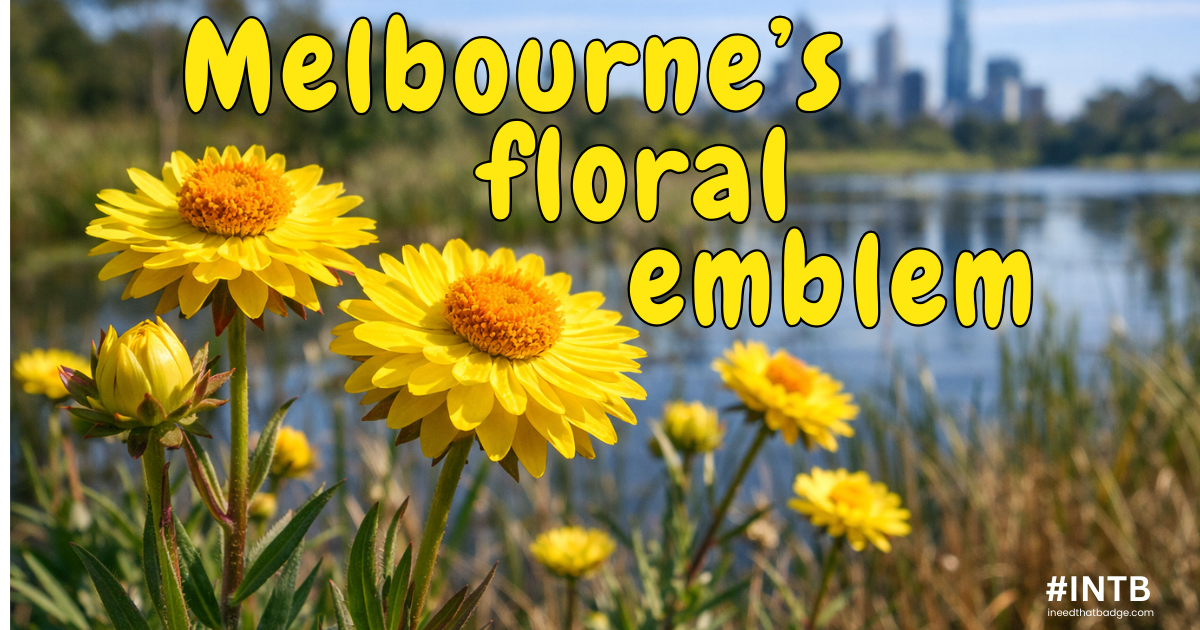
The City of Melbourne has recently adopted its very first official floral emblem — the delicate and historically significant Swamp Everlasting.
As part of the City of Melbourne’s “Nature in the City” initiative, the public were invited to vote for one of the nine native plants that were shortlisted as finalists for Melbourne’s floral emblem:
- Chocolate lily (Arthropodium strictum)
- Common billy buttons (Craspedia variabilis)
- Rounded noon-flower (Disphyma crassifolium subsp. clavellatum)
- Purple coral-pea (Hardenbergia violacea)
- Yam daisy (Murnong) (Microseris walteri)
- Austral storksbill (Pelargonium australe)
- Kangaroo grass (Themeda triandra)
- Tall bluebell (Wahlenbergia stricta subsp. stricta)
- Swamp everlasting (Xerochrysum palustre)
These nine species were selected as the shortlist by an expert reference group and refined from a long list of potential emblem species that met core criteria, including:
- Likelihood of occurring in the Melbourne municipality prior to European colonisation (i.e., indigenous)
- Ability to be supplied commercially
- Of a size and form that can be readily grown in a variety of public and private gardens
- Of cultural significance to Traditional Owners
Almost 25000 residents voted, selecting as the winner the bright yellow Swamp Everlasting to represent Melbourne’s natural heritage.
This native flower has a story closely tied to the landscape on which Melbourne was built.
A Flower with Local Roots
The Swamp Everlasting is a native daisy that once grew widely across the wetlands surrounding the lower Yarra River and the Moonee Ponds Creek area. Before Melbourne expanded into the large city we know today, these wetlands and grassy plains supported a diverse range of native plants and wildlife.
As the city developed, many of these natural environments were drained, built over, or heavily altered. As a result, the Swamp Everlasting became extremely rare in the wild.
Today the plant is considered rare and highly threatened. In Victoria it is listed as Critically Endangered on the Flora and Fauna Guarantee threatened species list, established under the Flora and Fauna Guarantee Act 1988. Nationally it is classified as Vulnerable under the Environment Protection and Biodiversity Conservation Act 1999.
By choosing this species as its official floral emblem, the City of Melbourne hopes to raise awareness about the conservation of native plants and the importance of protecting the region’s remaining natural habitats.
Like many members of the everlasting daisy family, the Swamp Everlasting has papery petals that retain their shape and colour even after drying. This distinctive feature is what gives everlasting daisies their name.
Australia has official floral emblems for the states and territories, but it is less common for individual cities to adopt one. That makes Melbourne’s decision to select the Swamp Everlasting particularly interesting. By choosing a species that once grew naturally across the Melbourne area, the city is recognising the importance of its original landscapes and encouraging people to learn more about local biodiversity.
Celebrating Nature in the City
Melbourne has long been known as a “Garden City”, famous for its parks, tree-lined boulevards, and botanical collections. From the Royal Botanic Gardens to neighbourhood parks and green corridors, plants and trees are an important part of Melbourne’s identity. This move towards a native floral emblem also reflects a growing interest in recognising Melbourne’s original landscapes and Indigenous ecological heritage.
Adopting the Swamp Everlasting as the city’s floral emblem strengthens this connection between Melbourne and the natural environment that existed long before the city developed.
The flower may also appear in future community plantings, educational programs, and conservation initiatives designed to highlight the importance of protecting native species and restoring local habitats.
The Swamp Everlasting may be a small flower, but it carries an important message. Even in the middle of a busy city, nature still matters — and protecting it is something everyone can help with.
Town Floral Emblems
Only a small number of Australian towns or cities have officially adopted floral emblems, and there is no standardised national list. When they do exist, they are often informal or symbolic rather than legally proclaimed. They are generally chosen by local councils, community votes, historical groups or tourism bodies, often based on civic symbols or notable local plants.
Some towns and cities appear to be associated with particular flowers, although this has been difficult to verify.
- Darwin – Red Kurrajong (Brachychiton megaphyllus)
- Alice Springs – Sturt’s Desert Rose (Gossypium sturtianum)
- Broken Hill – Sturt’s Desert Pea (Swainsona formosa)
- Cairns – Golden Penda (Xanthostemon chrysanthus)
- Bundaberg – Golden Penda (Xanthostemon chrysanthus)
- Ipswich – Plunkett Mallee (Eucalyptus curtisii)
- Coffs Harbour – Woolgoolga Lilly Pilly (Syzygium australe)
- Uralla – Cheiranthera telfordii
- Cooktown – Cooktown Orchid (Dendrobium bigibbum)
- Adelaide – Sturt’s Desert Pea (Swainsona formosa)
- Kalgoorlie–Boulder – Sturt’s Desert Pea (Swainsona formosa)
- Townsville – Blue Quandong / Golden Penda commonly promoted in council plantings
- Rockhampton – Rockhampton Bottle Tree (Brachychiton rupestris) sometimes treated symbolically in civic branding
- Mount Isa – Desert Pea frequently used as the city’s symbolic flower
- Halls Creek – Sturt’s Desert Pea promoted locally as a regional emblem
Some places also promote regional botanical symbols rather than strictly defined city emblems. For example:
- Ballarat has long been associated with the begonia, celebrating a Begonia Festival event each year
- Bendigo – sometimes associated with the Golden Wattle through historical civic crests
- Toowoomba – widely associated with garden flowers through the Carnival of Flowers, though no single official emblem exists.
Feel free to provide corrections and additions to this.
References and Further Reading
- Rodericks, A. (2026, March 6). Melbourne’s new floral emblem has been chosen – and it’s a critically endangered bloom. Time Out Melbourne.
- City of Melbourne. The floral finalists. Participate Melbourne.
- Royal Botanic Gardens Victoria. VicFlora – Xerochrysum palustre (Swamp Everlasting).
- Australian Native Plants Society (Australia). Preventing the extinction of the Swamp Everlasting in Victoria
- About The Garden Magazine. Floral Emblems of Australia.